Introduction
Choosing between CNC milling and CNC turning affects far more than machine time: it shapes part geometry, tolerance strategy, surface finish, and total procurement cost. For industrial buyers, the key is understanding how each process removes material, what part features it handles best, and where trade-offs appear in speed, complexity, and consistency. This overview clarifies the core mechanical differences between milling and turning, then connects those differences to quoting, supplier selection, and manufacturability. By the end, you will have a practical basis for deciding which process fits a specific component, volume requirement, and quality target.
CNC milling vs CNC turning: process differences
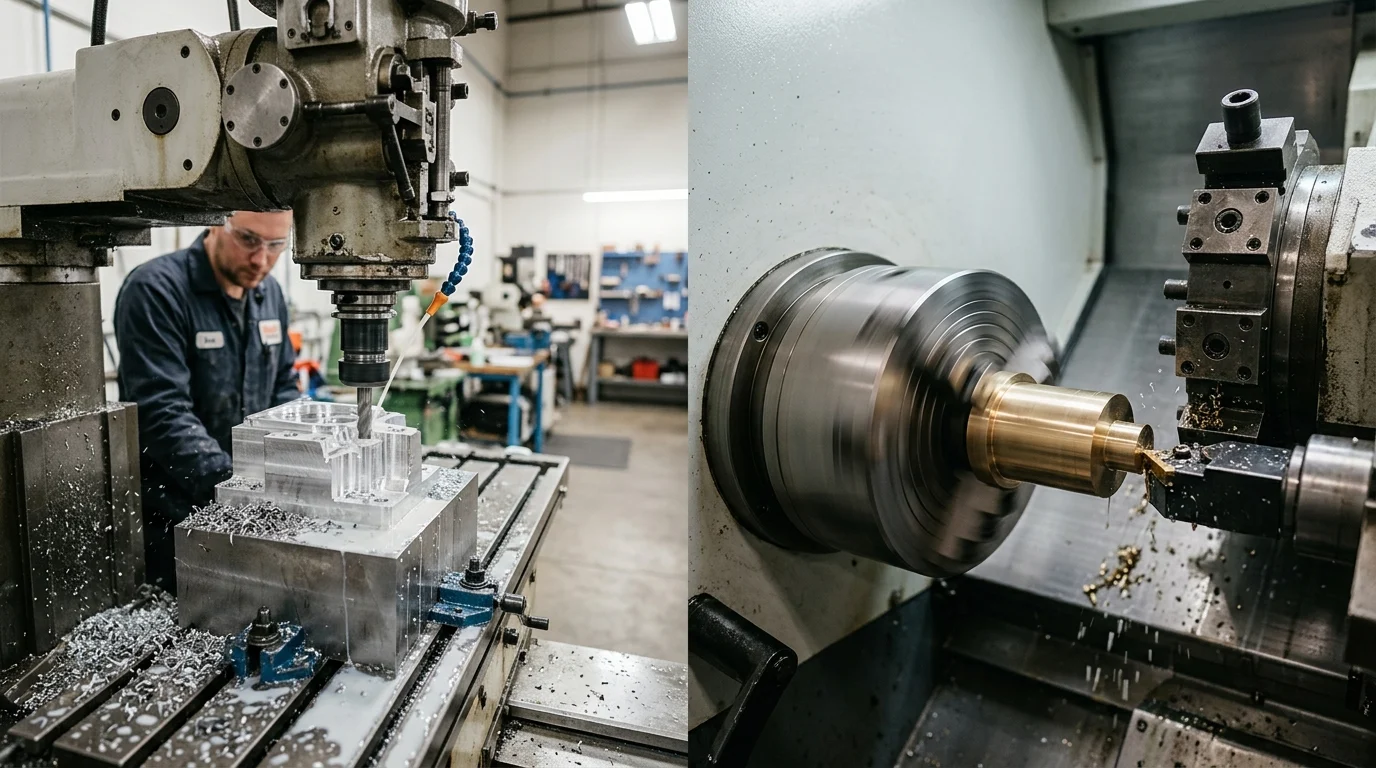
At the core of subtractive manufacturing, the distinction between CNC milling and CNC turning dictates the geometric possibilities, production efficiency, and mechanical integrity of machined components. While both processes rely on computer numerical control to govern toolpaths, their fundamental kinematics operate in inverse paradigms.
In CNC milling, the workpiece remains stationary or is manipulated along specific axes while multi-point rotary cutting tools remove material to create complex, prismatic shapes. Conversely, CNC turning secures cylindrical raw material in a rotating chuck, spinning the workpiece at high velocities against a stationary, single-point cutting tool. Understanding how these mechanical differences influence production is critical for engineering teams specifying tolerances and supply chain professionals managing procurement.
Tool motion, workholding, and axis capability
The primary kinematic difference between the two processes lies in the axis configuration and workholding strategies. CNC milling centers utilize sophisticated fixturing—such as vises, clamps, or custom tombstones—to secure the blank. Standard milling operations occur across 3 axes (X, Y, and Z), while advanced 4-axis and 5-axis machines introduce rotational movement (A and B axes) to navigate undercuts and complex contours without repositioning the part. Modern milling spindles routinely operate at velocities between 10,000 and 24,000 RPM to achieve optimal chip loads on multi-flute end mills.
CNC turning centers, or lathes, operate primarily on a 2-axis coordinate system (X and Z). The raw material, typically bar stock, is held in a collet or chuck. Because the workpiece itself generates the cutting speed, turning is inherently limited to producing axisymmetric profiles. However, the advent of mill-turn centers and Swiss-style lathes has blurred these boundaries, allowing live tooling to perform off-axis drilling and light milling on a turned part within a single setup.
Tolerances, surface finish, and material fit
Process selection heavily influences the achievable dimensional accuracy and surface finish. CNC turning excels at maintaining strict concentricity and runout tolerances, routinely achieving diametric precision down to ±0.005 mm (±0.0002 inches) on rigid setups. The continuous engagement of a single-point tool in turning also yields highly predictable surface finishes, typically ranging from Ra 0.4 to 1.6 µm depending on the insert geometry and feed rate.
CNC milling accommodates a broader array of geometries, including flat surfaces, deep pockets, and non-symmetrical features. However, the interrupted cutting action of a milling tool can induce vibration and deflection, particularly when machining thin-walled structures or utilizing extended-reach tooling. Both processes are highly adaptable to a wide spectrum of materials, from aerospace-grade titanium to engineering polymers. To explore how these processes adapt to specific industry requirements, engineers often review detailed industrial applications to align material properties with the appropriate machining methodology.
CNC milling vs CNC turning: cost and lead time
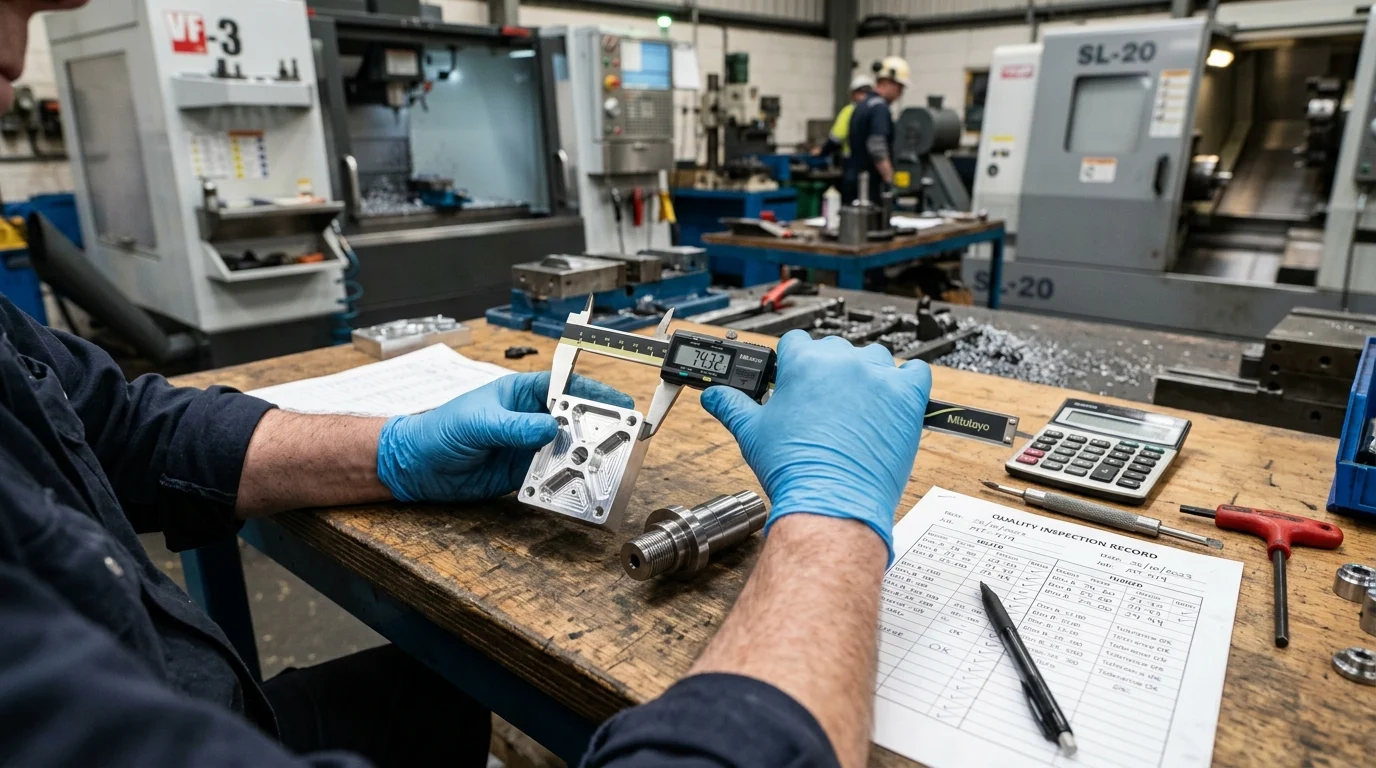
Beyond geometric capabilities, the economic implications of CNC milling versus CNC turning are paramount for procurement strategies. The architectural differences between the machines directly impact setup times, tooling expenditures, and cycle durations, all of which aggregate into the final per-part cost.
Industrial buyers must evaluate these variables against production volumes and lifecycle requirements. Misaligning the part design with the manufacturing process frequently results in excessive machine hours, inflated tooling budgets, and extended lead times.
Key cost drivers
Several quantifiable metrics drive the cost differential between milling and turning. Machine hourly rates are a primary factor; a standard 2-axis CNC lathe typically costs between $40 and $80 per hour to operate, whereas a 3-axis or 5-axis CNC mill commands $75 to $150 per hour due to higher capital depreciation and maintenance complexities. Furthermore, milling requires custom workholding for complex geometries, escalating initial setup costs and lead times.
Tooling consumption also varies significantly. Turning relies on relatively inexpensive single-point carbide inserts, whereas milling utilizes costly solid carbide end mills and face mills that degrade faster due to thermal shock from interrupted cutting.
| Cost Factor | CNC Turning | CNC Milling |
|---|---|---|
| Machine Hourly Rate | $40 – $80 / hr | $75 – $150 / hr |
| Setup Complexity | Low to Moderate | Moderate to High |
| Tooling Cost | Low (Single-point inserts) | High (Multi-flute cutters) |
| Cycle Time (Cylindrical) | Very Fast | Slow (Inefficient) |
| Cycle Time (Prismatic) | N/A | Fast |
How buyers should choose the right process
Selecting the optimal process requires analyzing the component’s primary geometry, required production volume, and target budget. If a part’s volume is greater than 60% cylindrical, turning is almost invariably the more economical choice. For high-volume production exceeding 1,000 units, Swiss-style turning centers offer unmatched efficiency, often completing parts in a single operation with cycle times measured in seconds.
Conversely, components requiring asymmetrical features, flat profiles, or complex 3D surfacing necessitate CNC milling. When parts exhibit both cylindrical and prismatic features, buyers must weigh the cost of sequential operations (turning followed by milling) against the higher hourly rate of a multi-tasking mill-turn center. Engaging with an experienced manufacturing partner is critical for optimizing this decision; procurement teams can seek specialized guidance by reaching out through an official contact portal to conduct a thorough design-for-manufacturability (DFM) review before finalizing purchase orders.
Key Takeaways
- The most important conclusions and rationale for CNC milling vs CNC turning
- Specs, compliance, and risk checks worth validating before you commit
- Practical next steps and caveats readers can apply immediately
Frequently Asked Questions
When should industrial buyers choose CNC turning over CNC milling?
Choose turning for cylindrical, axisymmetric parts needing tight concentricity, fast cycle times, and lower cost from bar stock.
What part features are better suited to CNC milling?
Milling is better for flats, pockets, slots, keyways, angled faces, and non-symmetrical or multi-sided geometries.
Which process is usually more cost-effective for simple round parts?
CNC turning is usually more economical because setup is simpler, inserts cost less, and cycle times are faster on round parts.
How do tolerances and surface finish compare between milling and turning?
Turning typically delivers better concentricity and smoother cylindrical finishes, while milling can hold tight dimensions on complex features with proper fixturing.
Can one supplier combine milling and turning in a single setup?
Yes. Mill-turn centers and Swiss machines can add off-axis drilling or light milling, reducing setups, lead time, and handling errors.