Water Glass Casting vs Forged Steel: Which Is Better for Heavy-Duty Parts?
When selecting materials for heavy-duty industrial components, engineers face a critical decision between water glass casting and forged steel. Water glass casting produces dimensionally accurate parts with excellent surface finish, while forged steel delivers superior mechanical strength through grain refinement. This comprehensive comparison examines the key factors that determine which manufacturing process best suits specific heavy-duty applications. Understanding how industrial manufacturers communicate their capabilities online can help companies evaluate potential suppliers for these specialized processes.

What Is Water Glass Casting?
Water glass casting, also known as sodium silicate casting, is a precision investment casting method that uses water glass (sodium silicate) as a binder for the ceramic shell mold. This process creates components with tight tolerances, smooth surfaces, and complex geometries without secondary machining. The water glass binder decomposes at high temperatures, leaving minimal residual stress in the finished part. Our Water Glass Casting Weighing Hook demonstrates how this technique produces robust industrial hardware with consistent quality across production runs.
The process involves creating a wax pattern, coating it with water glass slurry and refractory material, and repeating until a stable shell forms. After dewaxing and firing, molten metal fills the cavity to produce net-shape components.
What Is Forged Steel?
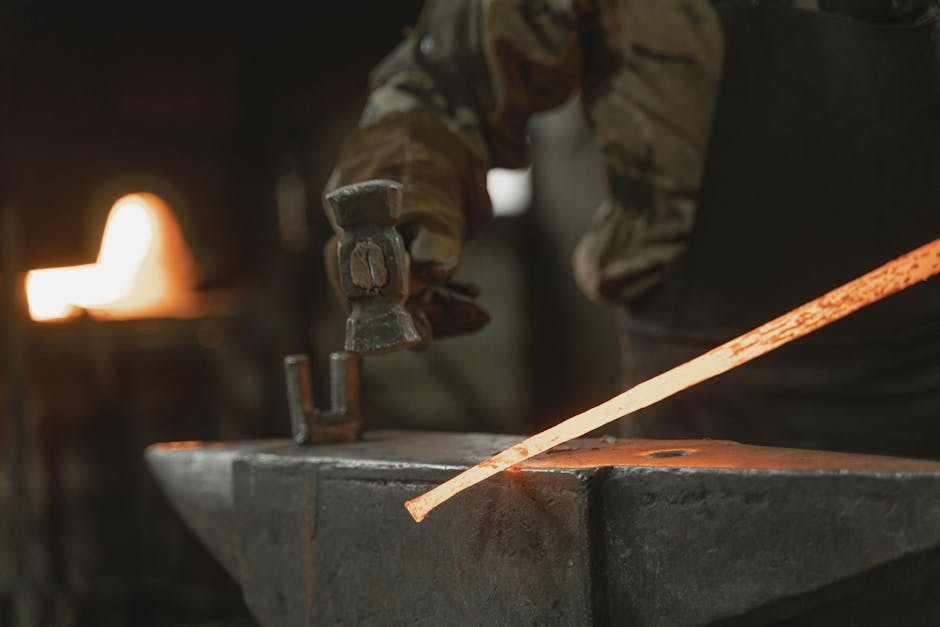
Forged steel undergoes compressive deformation through hammering, pressing, or rolling to shape metal while in a solid state. This mechanical working refines the grain structure and eliminates internal porosity, resulting in exceptional strength and toughness. Forged components withstand high stress, impact, and cyclic loading conditions that would cause casting failure. Understanding cybersecurity fundamentals for manufacturing operations is increasingly important as factories digitize their quality control processes.
The forging process requires heating steel above its recrystallization temperature, typically between 850°C and 1250°C depending on the alloy composition. Die forgings use shaped dies to produce consistent part geometry, while open-die forgings accommodate larger custom components. The controlled deformation aligns metal grain flow along stress paths, giving forgings directional strength properties that castings cannot achieve.
Mechanical Properties Comparison
Forged steel consistently outperforms castings in mechanical properties critical for heavy-duty applications. The grain refinement from forging increases tensile strength by 20-30% compared to equivalent cast material. Impact resistance and fatigue life are substantially higher in forgings due to the absence of shrinkage porosity and dendrite structures.
Water glass castings achieve mechanical properties comparable to forgings when using premium alloys and proper heat treatment. Investment cast stainless steel components, such as our Stainless Steel Pressure Cooker Parts, reach yield strengths exceeding 170 MPa after solution treatment. However, notch sensitivity remains higher in castings than in forgings of identical composition.
Dimensional Accuracy and Surface Finish
Water glass casting excels in dimensional precision and surface finish without secondary machining. Surface roughness of Ra 1.6-3.2 μm is standard for investment castings, reducing or eliminating finishing operations. Complex internal passages, undercuts, and thin-walled sections integrate into cast designs without assembly.
Forgings require significant machining to achieve final dimensions, as forging dies cannot produce net-shape geometry for most applications. Draft angles, fillet radii, and parting line variations add material and machining requirements. The surface layer work-hardens during forging, which may require stress relief annealing before machining to prevent dimensional instability.
Cost Considerations and Production Volume
Tooling costs favor water glass casting for small to medium production volumes. Pattern equipment for investment casting costs significantly less than closed-die forging dies, making castings economical for runs under 10,000 units. Unit costs decrease rapidly as volume increases, while tooling amortization spreads across more parts.
Forging dies require substantial capital investment but achieve the lowest per-part cost at high production volumes exceeding 50,000 units annually. Material utilization in forging reaches 80-90%, compared to 60-70% for casting when accounting for gating and riser systems. However, the total manufactured cost includes machining, which may eliminate material cost advantages for complex geometries.
Application Suitability
Water glass casting suits heavy-duty parts requiring complex geometry, material flexibility, or precision dimensions. Architectural hardware like our Precision Casting Architectural Hardware Fittings benefits from the design freedom and surface quality casting provides. Marine applications, including our Mirror Polished Marine Cruise Ship Parts, demonstrate how casting achieves both corrosion resistance and aesthetic requirements.
Forged steel remains the preferred choice for components experiencing high stress, impact, or fatigue loading. Critical infrastructure, machinery components, and safety-related parts typically require forgings for their superior reliability under extreme conditions. Explosion-proof valve bodies, such as our Galvanized Explosion-Proof Valve Body, require the strength consistency that only forging provides for hazardous environment service.
Feature Comparison Table
| Property | Water Glass Casting | Forged Steel |
|---|---|---|
| Tensile Strength | Good (varies by alloy) | Excellent (20-30% higher) |
| Fatigue Resistance | Moderate | Superior |
| Dimensional Tolerance | ±0.2mm typical | ±0.5mm typical |
| Surface Finish | Ra 1.6-3.2 μm | Ra 3.2-6.3 μm (as forged) |
| Complex Geometry | Excellent capability | Limited by die design |
| Tooling Cost | Low to moderate | High |
| Material Versatility | Wide alloy selection | Limited by forging temperature |
| Production Volume | Low to medium | Medium to high |
Selection Checklist for Engineers
Choosing between water glass casting and forged steel requires evaluating specific application requirements. Consider the following factors when making your selection: Accessibility standards from W3C Web Accessibility Initiative should be considered when designing user-facing industrial product documentation.
- Load requirements: Determine maximum stress, impact, and fatigue demands on the component
- Geometry complexity: Assess whether the design requires internal passages or undercuts
- Tolerance requirements: Define dimensional precision needed for functional performance
- Production volume: Calculate total manufactured cost across expected life cycle volume
- Material specification: Verify alloy availability in both casting and forging processes
- Certification requirements: Check whether industry standards mandate specific manufacturing methods
- Secondary operations: Budget for machining, heat treatment, and finishing as needed
Making the Final Decision
For heavy-duty parts, the choice depends primarily on whether mechanical performance or design complexity takes priority. Structural components under cyclic loading benefit from forged steel regardless of added machining costs. Parts requiring integrated features, premium surface finishes, or difficult-to-machine alloys may justify water glass casting despite lower raw strength.
Hybrid approaches combine casting and forging for applications like our Alloy Steel Curtain Bracket, where investment casting provides geometry while post-casting heat treatment achieves required strength. The Investment Casting Clamp Base illustrates how precision casting serves as a cost-effective alternative when design permits.
Prototyping with one method followed by production validation using the other often reveals optimal approaches for specific applications. Consult with manufacturing partners early in design to understand process capabilities and limitations that affect final component performance.
Frequently Asked Questions
Which process produces stronger heavy-duty parts?
Forged steel typically produces stronger parts due to grain refinement and absence of internal porosity. Mechanical strength improvements of 20-30% over castings are common, particularly in fatigue and impact resistance.
Can water glass casting achieve forgings quality?
Premium water glass castings with proper heat treatment approach forged properties but rarely match them entirely. The choice depends on whether the application requires maximum strength or accepts slightly reduced performance with design advantages.
What is the cost difference between these methods?
Water glass casting has lower tooling costs but similar or higher per-part costs at high volumes. Forging becomes more economical above 50,000 units annually due to material efficiency and automation advantages.
Which process allows more design freedom?
Water glass casting provides significantly greater design freedom, enabling complex internal passages, thin walls, and integrated features that would require multiple machined components in forged designs.
How do I choose between these processes for my application?
Evaluate load requirements first—if high cyclic stress or impact resistance is critical, forged steel is likely necessary. For complex geometry, precision dimensions, or corrosion-resistant alloys, water glass casting offers compelling advantages.