Top 7 Most Trusted Solar Mounting Precision Base Manufacturers in China
Introduction: Why Choose Solar Mounting Precision Base Manufacturers in China?
Solar mounting precision base manufacturers in China provide critical structural components for photovoltaic mounting systems, supporting stable installation and long-term operation of solar projects. This guide evaluates trusted Chinese manufacturers based on precision casting capability, material quality, manufacturing processes, customization services, and suitability for renewable energy applications.
Solar mounting precision bases are essential components that connect photovoltaic structures with foundations while maintaining mechanical stability under outdoor conditions. For solar EPC companies, mounting system suppliers, and industrial buyers, selecting a reliable manufacturer helps improve installation accuracy, reduce structural risks, and support long-term photovoltaic system performance.
1. What Are Solar Mounting Precision Bases?
Solar Mounting Precision Bases Are Structural Components That Support Photovoltaic Installation Systems
Solar mounting precision bases are specially manufactured metal components used in photovoltaic mounting structures to provide stable connections between solar panels, support frames, and foundations.
These precision components are designed to handle mechanical loads caused by:
- Solar panel weight
- Wind pressure
- Snow loads
- Temperature changes
- Long-term outdoor exposure
Unlike general metal brackets, precision bases require accurate dimensions and reliable material performance because small manufacturing errors can affect installation efficiency and structural stability.
Common applications include:
- Ground-mounted solar systems
- Commercial rooftop photovoltaic projects
- Industrial solar installations
- Renewable energy infrastructure
Precision Manufacturing Determines Solar Mounting Base Performance
The performance of solar mounting precision bases depends heavily on manufacturing accuracy, material selection, and surface treatment quality.
Key manufacturing requirements include:
- Precise dimensional control
- High mechanical strength
- Corrosion resistance
- Stable production consistency
- Long service life
Solar mounting components are usually exposed to outdoor environments for decades, making durability an important consideration during supplier selection.
Manufacturers with advanced casting and machining capabilities can produce components that meet different photovoltaic project requirements.
2. Why Solar Mounting Precision Base Manufacturers in China Are Important for PV Projects?
Chinese Solar Mounting Precision Base Manufacturers Provide Integrated Manufacturing Capabilities
Chinese solar mounting precision base manufacturers have become important suppliers for global photovoltaic projects because they combine casting technology, machining capability, and manufacturing flexibility.
International buyers often choose Chinese manufacturers because suppliers can provide:
- Precision casting services
- Custom component development
- Large-scale production
- Competitive manufacturing solutions
- Export support
For photovoltaic mounting system companies, working with experienced manufacturers can simplify component sourcing and improve supply chain efficiency.
Manufacturers specializing in precision metal components, such as lost wax casting parts and investment casting parts, can provide customized solutions for complex solar mounting structures.
Advanced Casting Technology Improves Solar Mounting Component Accuracy
Casting technology is a key factor when evaluating solar mounting precision base manufacturers in China because many mounting components require complex shapes and tight dimensional tolerances.
Common manufacturing processes include:
- Investment casting
- Lost wax casting
- Stainless steel casting
- Carbon steel casting
- Precision machining
Investment casting is commonly used for components requiring detailed structures and accurate dimensions.
The process generally includes:
- Wax pattern creation
- Ceramic shell formation
- Metal casting
- Surface finishing
- Quality inspection
This manufacturing method allows suppliers to produce components with complex geometries while maintaining dimensional accuracy.
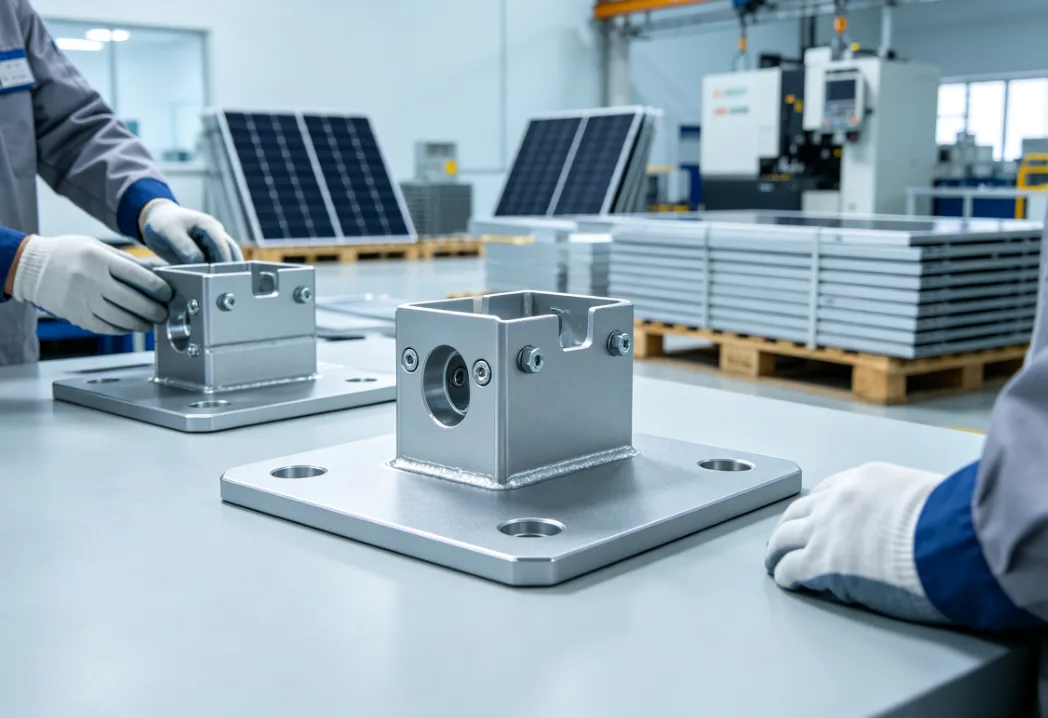 Customized Manufacturing Supports Different Solar Mounting Designs
Customization capability is important because photovoltaic mounting systems vary according to project location, panel type, and installation method.
Solar mounting precision base manufacturers may provide customized solutions involving:
- Component dimensions
- Material selection
- Surface treatment
- Connection design
- Production specifications
OEM buyers should communicate technical drawings, performance requirements, and application conditions before production.
Manufacturers with engineering support can help optimize component design and improve manufacturing feasibility.
3. How to Evaluate Solar Mounting Precision Base Manufacturers in China?
Material Selection Determines Outdoor Durability
Material selection is one of the most important evaluation factors for solar mounting precision base manufacturers because components must withstand outdoor environments for extended periods.
Common materials include:
| Material | Main Characteristics | Typical Applications |
|---|---|---|
| Stainless steel | High corrosion resistance | Coastal and outdoor projects |
| Carbon steel | High strength and cost efficiency | Structural components |
| Alloy steel | Improved mechanical performance | Heavy-load applications |
The correct material depends on environmental conditions, load requirements, and project specifications.
Precision Machining Ensures Installation Compatibility
Precision machining is essential because solar mounting systems require accurate component connections during installation.
Important machining capabilities include:
- CNC machining
- Dimensional control
- Hole positioning accuracy
- Surface finishing
- Tolerance management
Accurate machining helps reduce installation difficulties and improves compatibility between different mounting components.
Quality Control Systems Reduce Solar Project Risks
Quality control is a critical factor when selecting solar mounting precision base manufacturers in China because component defects can affect installation efficiency and structural reliability.
A professional quality inspection process may include:
| Inspection Process | Purpose |
|---|---|
| Material inspection | Confirms raw material quality |
| Dimensional measurement | Ensures manufacturing accuracy |
| Mechanical testing | Verifies strength performance |
| Surface inspection | Checks finishing quality |
| Final inspection | Confirms product consistency |
Buyers should request quality documentation and sample testing before placing large orders.
Production Capacity Supports Long-Term Supply Stability
Production capacity determines whether manufacturers can support large photovoltaic projects and repeat orders.
Important evaluation points include:
- Factory production equipment
- Manufacturing workforce
- Quality management system
- Monthly production capability
- Supply chain management
For EPC companies and mounting system suppliers, stable production capacity helps avoid project delays caused by component shortages.
4. Top 7 Most Trusted Solar Mounting Precision Base Manufacturers in China
Manufacturer 1: NBSJ Casting – Precision Casting Manufacturer
NBSJ Casting is a Chinese manufacturer specializing in precision metal casting components for industrial applications. The company provides casting solutions that can support customized component requirements, including renewable energy-related applications.
Main product categories include:
- Solar mounting precision bases
- Lost wax casting parts
- Metal investment casting components
- Precision casting parts
- Custom metal casting products
For solar mounting projects, manufacturers with precision casting capabilities can produce components requiring complex structures, accurate dimensions, and consistent quality.
Related products include:
Suitable Applications
NBSJ Casting-related manufacturing capabilities can support:
- Solar mounting structures
- Industrial equipment components
- Mechanical parts
- Energy equipment applications
For buyers sourcing customized photovoltaic mounting components, casting manufacturers with engineering and production experience can provide flexible solutions.
Manufacturer 2: Chinese Investment Casting Manufacturers
Chinese investment casting manufacturers provide precision metal components for industries requiring accurate dimensions and complex structures.
Their manufacturing advantages include:
- Complex component production
- High dimensional accuracy
- Material flexibility
- Custom engineering support
Investment casting suppliers are commonly used in industries such as:
- Renewable energy
- Industrial equipment
- Automotive components
- Mechanical systems
For solar mounting precision base applications, buyers should evaluate whether suppliers have experience producing outdoor structural components.
Manufacturer 3: Chinese Stainless Steel Casting Component Manufacturers
Stainless steel casting manufacturers provide corrosion-resistant components suitable for demanding outdoor environments.
Stainless steel is often selected for solar mounting applications because it provides:
- Corrosion resistance
- Long-term durability
- Stable mechanical performance
- Reduced maintenance requirements
These manufacturers are suitable for projects located in:
- Coastal regions
- Humid environments
- Industrial areas
- Outdoor infrastructure projects
When selecting stainless steel casting suppliers, buyers should review material grades, casting quality, and surface treatment capabilities.
4. Top 7 Most Trusted Solar Mounting Precision Base Manufacturers in China (Continued)
Manufacturer 4: Chinese Custom Metal Casting Factories
Chinese custom metal casting factories provide flexible manufacturing solutions for solar mounting precision bases and other customized photovoltaic components. These manufacturers are suitable for buyers requiring non-standard designs, special materials, or project-specific structures.
Custom casting manufacturers usually support:
- Engineering drawing analysis
- Prototype development
- Small-batch production
- Mass manufacturing
- Surface treatment services
For solar mounting system suppliers, customized manufacturing is important because photovoltaic projects may involve different installation environments, structural designs, and load requirements.
Typical customization requirements include:
- Base dimensions
- Mounting hole positions
- Connection structures
- Material specifications
- Surface finishing requirements
A capable custom metal casting supplier can help buyers transform engineering concepts into production-ready components.
Manufacturer 5: Chinese Precision Machining and Casting Suppliers
Chinese precision machining and casting suppliers combine casting processes with advanced machining technology to produce accurate solar mounting components.
These manufacturers are suitable for applications requiring:
- Tight dimensional tolerances
- Complex geometries
- Smooth surface finishes
- Consistent production quality
The combination of casting and machining allows manufacturers to improve component accuracy after the initial forming process.
Typical production processes include:
- Engineering drawing review
- Casting process design
- Rough component production
- CNC machining
- Surface treatment
- Final inspection
For solar mounting precision base production, combined manufacturing capability can improve installation compatibility and reduce assembly problems.
Manufacturer 6: Chinese Industrial Component Manufacturers
Chinese industrial component manufacturers provide metal parts for various industries, including renewable energy, mechanical equipment, and structural applications.
These manufacturers often have experience producing:
- Precision metal components
- Structural connection parts
- Mechanical casting products
- Customized industrial parts
Their advantages include:
- Mature manufacturing systems
- Professional quality management
- Diverse material options
- Engineering experience
For photovoltaic projects, industrial component manufacturers can support buyers who require customized solar mounting precision bases along with other metal components.
Manufacturer 7: Export-Oriented Chinese Casting Manufacturers
Export-oriented Chinese casting manufacturers focus on serving international customers and usually have experience with global quality requirements and supply procedures.
These suppliers typically provide:
- International shipping support
- Quality documentation
- Technical communication
- Packaging solutions
- Project-based manufacturing
For global solar companies, export experience can reduce procurement challenges and improve cooperation efficiency.
Important evaluation factors include:
- Previous international projects
- Manufacturing certifications
- Inspection procedures
- Communication efficiency
- Delivery management
A manufacturer with export experience can better support long-term cooperation with overseas photovoltaic companies.
5. Comparison of Solar Mounting Precision Base Manufacturers in China
Different types of manufacturers provide different advantages depending on project requirements. Solar EPC companies and mounting system suppliers should evaluate manufacturers based on technical capability, quality control, and customization requirements.
| Evaluation Factor | Why It Matters for Solar Projects |
|---|---|
| Casting accuracy | Ensures precise installation and component compatibility |
| Material performance | Improves outdoor durability and corrosion resistance |
| Machining capability | Supports accurate assembly and structural stability |
| Customization ability | Meets different photovoltaic system designs |
| Quality inspection | Reduces component failure risks |
| Production capacity | Supports large-scale project supply |
A reliable solar mounting precision base manufacturer should provide consistent production quality, technical support, and stable delivery capability.
6. How to Select the Right Solar Mounting Precision Base Manufacturer in China?
Step 1: Define Solar Project Requirements Before Supplier Selection
The first step is identifying project requirements because solar mounting components vary according to installation environments and structural designs.
Important project factors include:
- Solar mounting system type
- Installation location
- Environmental conditions
- Load requirements
- Component dimensions
For example, solar projects in coastal regions may require stronger corrosion resistance compared with inland installations.
Step 2: Confirm Manufacturing Processes and Technical Capability
The second step is evaluating whether manufacturers have suitable production processes for solar mounting precision bases.
Important manufacturing capabilities include:
- Investment casting
- Lost wax casting
- CNC machining
- Surface treatment
- Precision inspection
Buyers should confirm whether suppliers can manufacture components according to technical drawings and engineering specifications.
Products such as lost wax casting parts are commonly used for precision metal components requiring detailed structures and accurate dimensions.
Step 3: Review Quality Control Procedures
The third step is checking supplier quality management systems because photovoltaic structures require reliable components for long-term operation.
Recommended quality evaluation includes:
- Raw material inspection
- Casting defect inspection
- Dimensional measurement
- Mechanical performance testing
- Final product verification
A professional manufacturer should provide inspection records and quality documentation when required.
Step 4: Test Samples Before Large-Scale Production
Sample testing helps buyers verify whether solar mounting precision bases meet installation and performance requirements.
Recommended sample evaluation includes:
- Checking component dimensions.
- Confirming mounting compatibility.
- Testing surface quality.
- Reviewing material specifications.
- Evaluating installation performance.
Sample validation reduces risks before mass production.
7. Applications of Solar Mounting Precision Bases
Ground-Mounted Solar Systems Require Durable Precision Support Components
Ground-mounted solar systems commonly use precision bases to connect mounting structures with foundations and maintain panel stability.
Important requirements include:
- High mechanical strength
- Accurate positioning
- Weather resistance
- Long service life
Large solar farms require consistent component quality because thousands of mounting connections may be installed across the project.
Commercial Rooftop Solar Projects Need Accurate Mounting Components
Commercial rooftop photovoltaic systems require lightweight but reliable mounting solutions due to limited installation space and structural requirements.
Solar mounting precision bases help ensure:
- Stable panel positioning
- Secure structural connections
- Efficient installation processes
For commercial projects, component accuracy can directly influence installation efficiency.
Industrial Photovoltaic Systems Depend on Reliable Metal Components
Industrial solar projects often require customized mounting components because installation environments may involve larger structures and higher operational requirements.
Applications include:
- Factory rooftop systems
- Warehouse solar installations
- Industrial energy projects
Manufacturers with experience in precision metal components can better support these applications.
Renewable Energy Infrastructure Requires Long-Term Component Reliability
Renewable energy infrastructure requires components designed for decades of outdoor operation.
Solar mounting precision bases must withstand:
- Wind loads
- Temperature variation
- Rain exposure
- Environmental conditions
Selecting experienced manufacturers helps improve the long-term reliability of photovoltaic systems.
8. Future Trends of Solar Mounting Precision Base Manufacturing
Lightweight Design Is Influencing Solar Mounting Component Development
Lightweight structural design is becoming an important trend because photovoltaic projects increasingly focus on reducing installation complexity and transportation costs.
Manufacturers are improving designs through:
- Optimized structures
- Advanced materials
- Precision manufacturing
- Reduced material waste
Advanced Casting Technology Is Improving Manufacturing Efficiency
Advanced casting technology is helping solar mounting precision base manufacturers improve production accuracy and reduce manufacturing waste.
Future manufacturing improvements may include:
- Automated production processes
- Digital quality inspection
- Improved casting simulation
- More efficient material usage
These developments can help manufacturers provide more consistent components for global solar projects.
Sustainable Manufacturing Is Becoming More Important
Sustainable manufacturing is becoming a consideration for renewable energy supply chains because solar projects increasingly evaluate environmental impact throughout the product lifecycle.
Manufacturers are focusing on:
- Material efficiency
- Production optimization
- Waste reduction
- Energy-efficient processes
9. Final Guide to Selecting Solar Mounting Precision Base Manufacturers in China
The Right Solar Mounting Precision Base Manufacturer Should Match Project Requirements
Selecting the right solar mounting precision base manufacturer requires a comprehensive evaluation of manufacturing capability, material quality, production reliability, and customization support. A suitable supplier should not only provide metal components but also understand photovoltaic structural requirements and installation challenges.
Solar EPC companies, mounting system distributors, and engineering contractors should evaluate manufacturers based on long-term cooperation potential rather than only initial component pricing.
A professional supplier selection process should include:
- Define project specifications and technical requirements.
- Evaluate manufacturer production capability.
- Review casting and machining processes.
- Confirm quality inspection procedures.
- Conduct sample testing before mass production.
- Establish communication and delivery standards.
Manufacturing Experience Is a Key Factor When Choosing Solar Mounting Precision Base Suppliers
Manufacturing experience directly affects component quality because solar mounting precision bases require accurate production and consistent performance.
Experienced manufacturers usually provide:
- Professional engineering support
- Stable production processes
- Advanced manufacturing equipment
- Quality management systems
- Custom component development
For buyers requiring customized photovoltaic components, manufacturers with precision casting experience can provide more suitable production solutions.
Products such as metal investment casting and precision casting parts demonstrate the importance of accurate metal forming technology in industrial component manufacturing.
Quality and Reliability Should Be Prioritized Over Low Purchase Cost
Component reliability is more important than selecting the lowest-priced solar mounting precision base supplier because photovoltaic systems are designed for long-term outdoor operation.
Low-quality components may create problems such as:
- Installation difficulties
- Structural instability
- Increased maintenance requirements
- Project delays
A reliable supplier should provide:
- Consistent product dimensions
- Stable material performance
- Proper inspection records
- Production traceability
For large solar projects, quality consistency helps reduce long-term operational risks.
Conclusion: Choosing Trusted Solar Mounting Precision Base Manufacturers in China
Solar mounting precision base manufacturers in China provide important components for photovoltaic mounting systems, renewable energy infrastructure, and industrial applications. Their precision casting capability, customization services, and manufacturing experience make them valuable partners for global solar companies.
The best manufacturer choice depends on several factors, including:
- Casting and machining capability
- Material selection
- Quality control systems
- Customization support
- Production capacity
- Export experience
For solar EPC companies and mounting system suppliers, selecting a reliable manufacturing partner can improve project efficiency and support long-term photovoltaic system performance.
A professional solar mounting precision base manufacturer should provide accurate components, stable production, and technical cooperation throughout the project lifecycle.
By carefully evaluating supplier capabilities, reviewing samples, and confirming quality standards, buyers can identify suitable partners for future solar infrastructure projects.
Frequently Asked Questions About Solar Mounting Precision Base Manufacturers in China
1. What is a solar mounting precision base used for?
A solar mounting precision base is a structural component used in photovoltaic mounting systems to connect support structures with foundations or installation points. It helps maintain panel stability and improves mounting accuracy.
2. Why do solar companies choose manufacturers in China for precision bases?
Solar companies choose Chinese manufacturers because many suppliers offer precision casting capability, customized production services, competitive manufacturing solutions, and experience serving international markets.
3. What materials are commonly used for solar mounting precision bases?
Common materials include stainless steel, carbon steel, and alloy steel. Material selection depends on project requirements such as corrosion resistance, mechanical strength, environmental conditions, and service life expectations.
4. How can buyers verify the quality of solar mounting precision base manufacturers?
Buyers can verify quality by reviewing manufacturing processes, checking inspection procedures, requesting samples, confirming material specifications, and evaluating production capability.
5. Can Chinese manufacturers customize solar mounting precision bases?
Yes, many Chinese manufacturers provide customized solar mounting precision bases based on engineering drawings, material requirements, dimensions, surface treatments, and specific photovoltaic system designs.