Introduction
Agricultural castings used in tillage, seeding, and harvesting face constant abrasion, impact, and soil-borne corrosion, so surface condition often determines service life more than bulk strength alone. This article explains which surface treatments most effectively improve wear resistance for agricultural machinery castings, including hardening, thermal spray coatings, overlay methods, and diffusion-based processes. It also clarifies how each option performs against common wear mechanisms, where it fits best by component type, and what trade-offs to expect in cost, toughness, and repairability. With that context, the discussion can move directly into comparing treatment methods and selecting the right approach for real field conditions.
How surface treatments improve wear resistance in agricultural machinery
Agricultural equipment operates in exceptionally abrasive environments, subjecting ground-engaging tools and structural components to continuous friction, impact, and corrosive elements. Because these components are directly responsible for the operational efficiency of the equipment, preventing premature degradation is a critical engineering priority.
To combat these harsh conditions in agricultural machinery casting applications, engineers rely heavily on advanced surface treatments. These metallurgical processes alter the exterior properties of a component, providing a hardened shield against environmental wear while preserving the core’s structural integrity.
Key wear mechanisms in agricultural machinery
The primary modes of degradation in agricultural settings are abrasive wear, erosive wear, and impact fatigue. Two-body and three-body abrasion occur when hard soil particles are trapped between moving metal surfaces or dragged across a stationary blade. This constant friction micro-machines the metal surface, leading to rapid material loss.
The severity of this wear is directly tied to the mineralogy of the soil. Quartz sand, a ubiquitous soil constituent, possesses a Vickers hardness ranging from 1000 to 1200 HV. Because standard carbon steel castings typically exhibit a baseline hardness of only 200 to 300 HV, the untreated base material is rapidly degraded without targeted metallurgical protection.
Surface treatment options vs base material upgrades
When engineering a solution for high-wear environments, OEMs must evaluate whether to upgrade the bulk material of the casting or apply a surface treatment to a standard alloy. Upgrading the entire casting to a premium wear-resistant material, such as high-chrome white iron, provides uniform hardness but often sacrifices ductility. This makes the component highly susceptible to brittle fracture upon impact with rocks.
Furthermore, upgrading bulk metallurgy can increase raw material costs by 40% to 60%. Surface treatments resolve this dichotomy by allowing the use of a ductile, low-alloy steel core that absorbs impact energy, while the exterior is modified to withstand abrasion. This composite approach optimizes the cost-to-performance ratio, ensuring the casting survives both high-impact shock loads and continuous frictional wear.
Best surface treatments for agricultural machinery
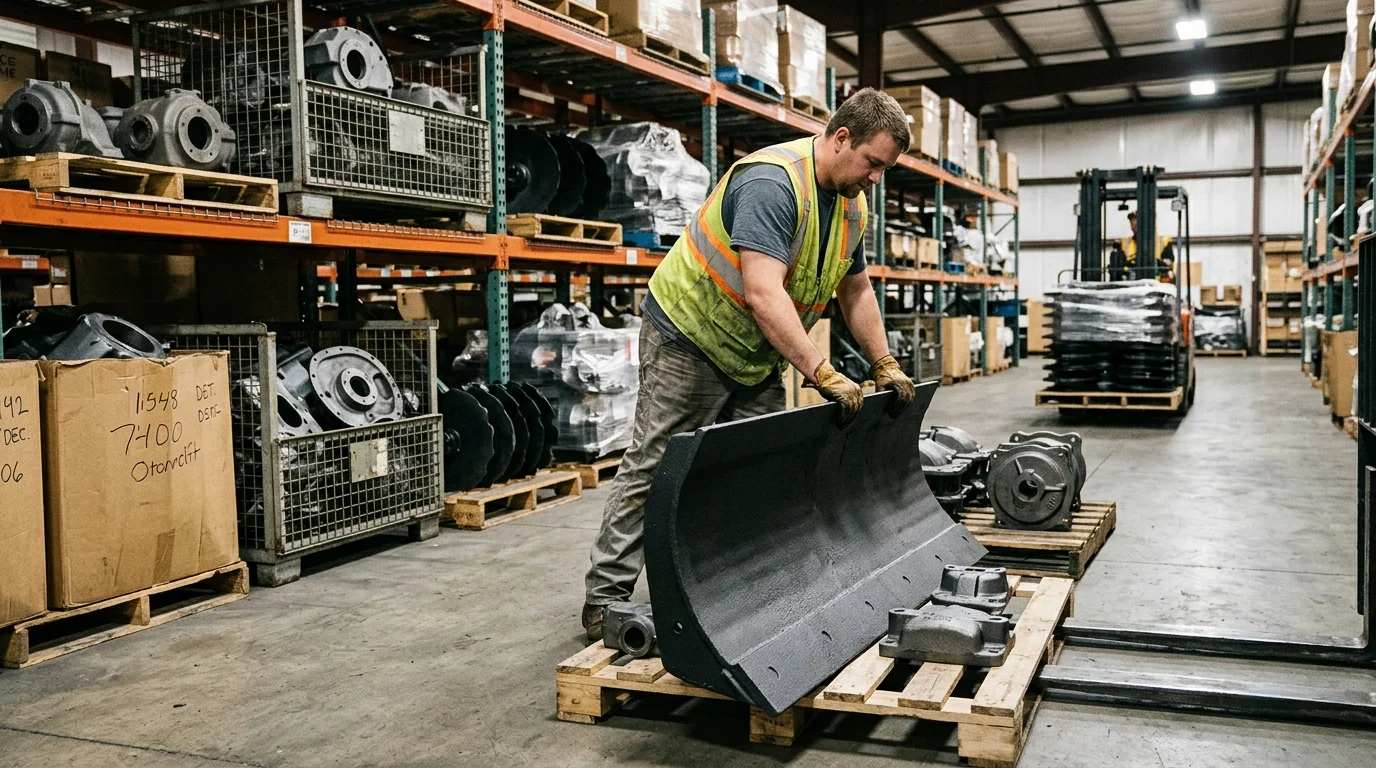
Selecting the optimal surface engineering technique requires matching the treatment’s metallurgical profile to the specific field conditions the agricultural machinery casting will face. Several distinct processes dominate the industry, each offering unique advantages in hardness, depth, and application methodology.
Hardfacing, induction hardening, carburizing, boriding, and ther
mal spray
Hardfacing involves depositing a thick layer of wear-resistant alloy, such as tungsten carbide or chromium carbide, via welding. This adds a substantial 3.0 mm to 5.0 mm of protective thickness, making it ideal for extreme abrasion and high-impact zones like plow points. Induction hardening, conversely, uses localized electromagnetic induction to rapidly heat and quench the surface, transforming the steel structure to martensite and achieving a hardness of 50 to 60 HRC.
Thermochemical diffusion processes modify the chemical composition of the surface layer. Carburizing diffuses carbon into a low-carbon steel surface, typically achieving a case depth of 1.0 mm to 3.0 mm. Boriding is a more specialized thermochemical process that diffuses boron into the matrix, creating an ultra-hard intermetallic layer capable of reaching 1500 to 2000 HV, though limited to a shallower depth of 50 to 150 microns. Finally, High-Velocity Oxygen Fuel (HVOF) thermal spray applies dense, thin coatings (0.1 mm to 0.3 mm) of cermet materials, offering exceptional wear resistance with minimal thermal distortion to the base casting.
Comparison criteria for buyers and OEMs
Procurement teams and design engineers must balance hardness, case depth, impact tolerance, and processing costs. A thicker, softer case may survive heavy rock impacts better than a thin, ultra-hard layer that could spall under stress.
| Treatment Method | Typical Hardness | Typical Case Depth | Impact Resistance | Relative Cost |
|---|---|---|---|---|
| Hardfacing | 55-65 HRC | 3.0 – 5.0 mm | High | Medium-High |
| Induction Hardening | 50-60 HRC | 1.0 – 5.0 mm | Medium | Low |
| Carburizing | 55-62 HRC | 1.0 – 3.0 mm | Medium | Medium |
| Boriding | 1500-2000 HV | 0.05 – 0.15 mm | Low | High |
| Thermal Spray (HVOF) | 1000-1300 HV | 0.1 – 0.3 mm | Low-Medium | Very High |
This comparative matrix highlights why induction hardening remains a dominant choice for high-volume structural components due to its low cost and adequate depth, whereas hardfacing is reserved for direct ground-engaging edges.
How to select and implement surface treatments
Strategic implementation of surface treatments requires strict alignment between design specifications, metallurgical capabilities, and supplier quality control. Partnering with an experienced foundry ensures that the base casting chemistry is compatible with the chosen hardening process, preventing defects such as quench cracking or coating delamination.
Qualification and implementation steps
The qualification process begins with metallurgical cross-sectioning of prototypes to verify case depth, microstructure, and hardness gradients. Laboratory testing, such as the ASTM G65 dry sand/rubber wheel abrasion test, provides baseline data for material loss under controlled abrasive conditions.
However, laboratory data must be validated through rigorous field trials. Industry standard practice dictates that agricultural castings undergo a minimum of 500 to 1,000 hours of active field operation in specific soil types (e.g., sandy loam vs. heavy clay) to accurately measure wear rates. During this phase, engineers monitor the components for localized spalling, premature dulling, and structural fatigue. Only after validating the field data and verifying the supplier’s process repeatability through quality assurance protocols should the treatment be approved for serial production.
Decision criteria for final selection
Final selection hinges on the Total Cost of Ownership (TCO) and logistical feasibility. Geometric complexity plays a major role; line-of-sight processes like thermal spray cannot coat internal bores, making thermochemical diffusion (like carburizing) necessary for complex geometries.
Production volume and Minimum Order Quantities (MOQs) also dictate the choice.
Key Takeaways
- The most important conclusions and rationale for agricultural machinery casting
- Specs, compliance, and risk checks worth validating before you commit
- Practical next steps and caveats readers can apply immediately
Frequently Asked Questions
Which surface treatment is best for plow points and other high-abrasion castings?
Hardfacing is usually the best choice. It adds a 3–5 mm wear layer and handles severe soil abrasion and repeated impact better than thin coatings.
When should agricultural castings use induction hardening instead of hardfacing?
Use induction hardening when you need a hardened surface with low distortion on steel castings, especially for localized wear zones that still require good core toughness.
Is boriding a good option for agricultural machinery casting parts?
Yes, for extreme abrasive wear with limited impact. Boriding creates a very hard surface, but its shallow layer is less suitable for heavy shock loads or rock strikes.
How does HVOF coating help wear-resistant agricultural castings?
HVOF applies a dense, thin coating with excellent wear resistance and minimal heat effect. It suits precision parts where dimensional control matters more than deep case depth.
Should buyers choose surface treatment or upgrade the whole casting alloy?
Surface treatment is often more cost-effective. It keeps a tough, ductile casting core while improving surface hardness, reducing the brittleness and higher material cost of full alloy upgrades.