Introduction
Hydraulic components leave little room for machining error: slight variation in diameter, concentricity, or surface finish can compromise sealing, raise leakage, and shorten service life under high pressure. Achieving tight tolerances in CNC turning therefore depends on more than nominal dimensions; it requires control of material behavior, machine condition, tooling, fixturing, and inspection as a connected process. This article explains the practical factors that most affect precision in turned hydraulic parts, how tolerance and finish requirements relate to real sealing performance, and what process controls help maintain repeatable results from first piece to production runs.
Why Hydraulic Parts Need Tighter Process Control in CNC Turning
Fluid power systems operate under extreme conditions, often managing system pressures ranging from 3,000 to over 10,000 PSI. At these operating pressures, the geometric accuracy of CNC turning hydraulic parts becomes the primary defense against internal fluid bypass, external leakage, and catastrophic system failure. When hydraulic fluid viscosity drops due to elevated operating temperatures, even microscopic clearance variations can result in significant efficiency losses. Tighter process control during machining ensures that components such as valve spools, cylinders, and high-pressure fittings maintain exact spatial relationships when assembled, preventing pressure drops and ensuring predictable actuator response times.
Pressure Sealing, Concentricity, and Surface Finish Requirements
Dynamic sealing interfaces demand exceptional surface integrity and geometric alignment. For elastomeric and polyurethane seals to function without rapid degradation, turning operations must consistently achieve surface finishes between Ra 0.4 µm and 0.8 µm. Furthermore, concentricity between the sealing gland and the primary bore is critical. A deviation of just 0.015 mm in concentricity can cause uneven seal compression, leading to premature wear and high-pressure fluid extrusion. Precision turning must mitigate tool deflection and harmonic vibration to maintain these strict micro-finish and alignment parameters, often utilizing active vibration damping systems.
Drawing Definitions, GD&T, and Functional Tolerances
Engineering drawings for hydraulic components rely heavily on Geometric Dimensioning and Tolerancing (GD&T) to communicate functional limits. Rather than simple linear tolerances, features like spool valves require strict cylindricity, straightness, and total runout controls, frequently held to within 0.005 mm. These GD&T callouts ensure that the spool can actuate smoothly within the valve body under thermal expansion without binding or allowing excessive clearance leakage. Process control must directly translate these theoretical boundaries into actionable machining parameters. This requires adjusting for material spring-back, managing residual stresses in the raw material, and compensating for thermal distortion during the turning cycle to maintain true position across complex internal geometries.
How to Achieve Tight Tolerances in CNC Turning for Hydraulic
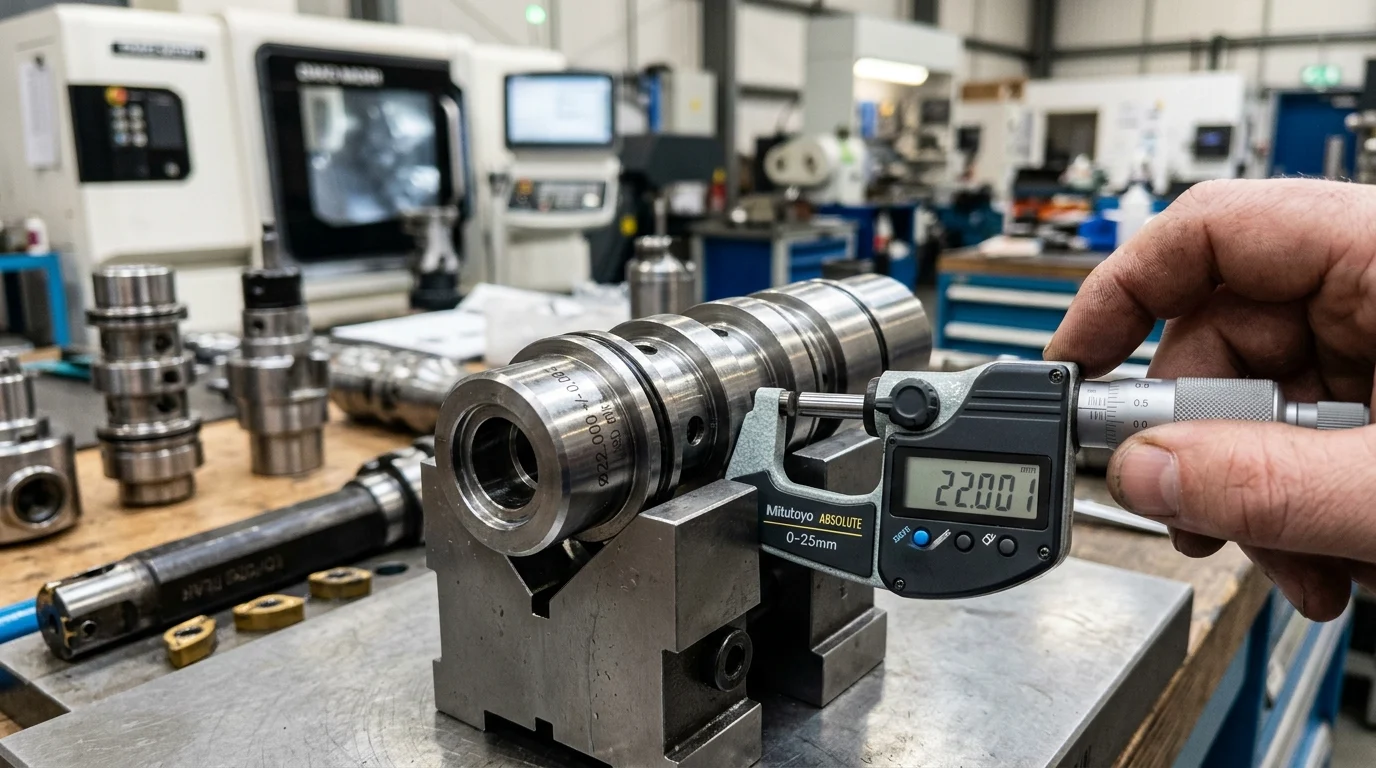
Achieving ultra-precise dimensional accuracy requires a holistic approach to the machining environment. Environmental temperature fluctuations, machine tool kinematics, and material inconsistencies can all introduce dimensional drift. The quality of the raw material, such as bar stock straightness and the absence of hard inclusions, directly dictates the stability of the turning process. Therefore, manufacturing facilities must implement rigid setups, thermal compensation algorithms, and advanced monitoring systems to counteract these variables when machining CNC turning hydraulic parts.
Machine Capability, Tooling, and Workholding Strategy
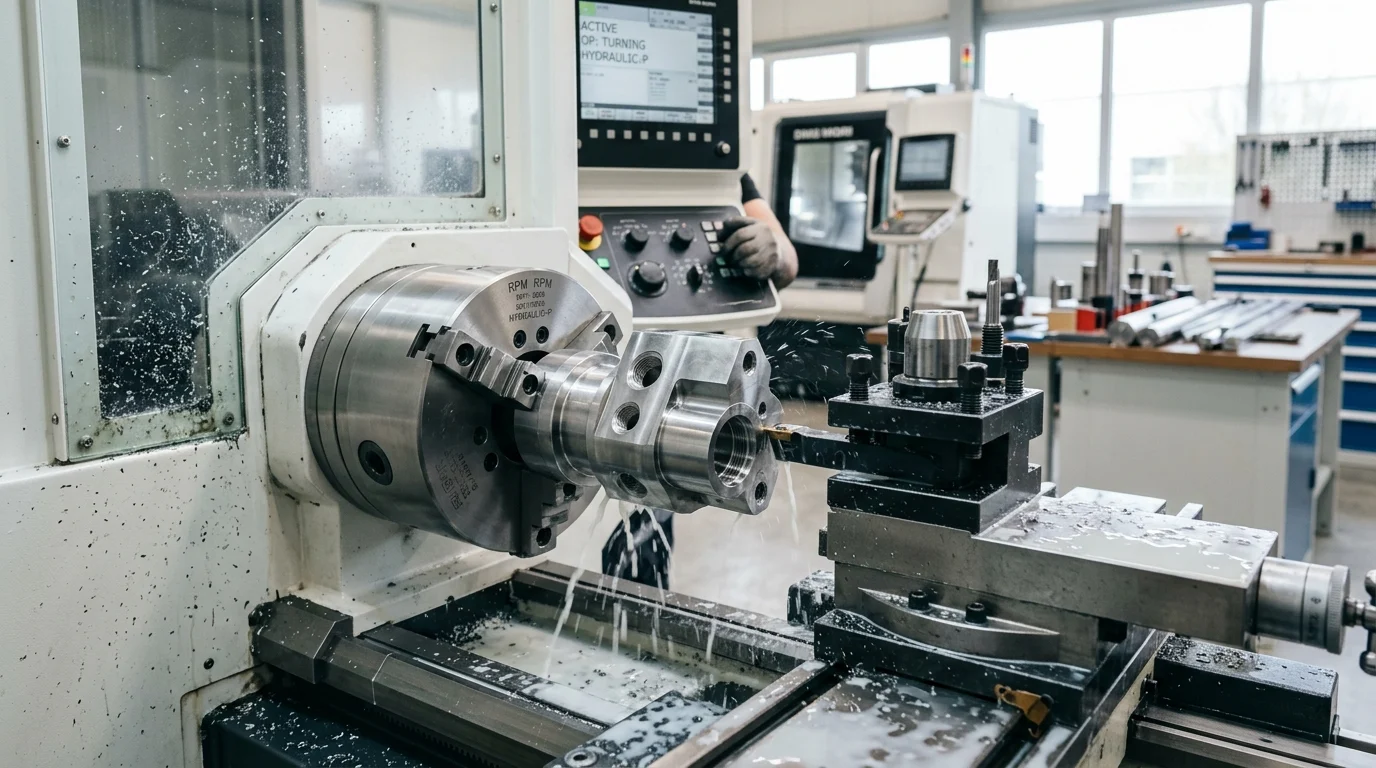
The foundation of precision turning lies in machine capability and workholding. CNC lathes dedicated to fluid power components must demonstrate exceptional axis repeatability, typically within ±0.002 mm, and utilize active spindle chillers to prevent thermal growth. Standard jaw chucks often induce radial distortion on thin-walled hydraulic cylinders; thus, piezoelectric collet systems or custom soft jaws bored to exact part diameters are utilized to distribute clamping forces evenly. Tooling selection is equally critical. Polished carbide or cermet inserts with sharp edge preparations reduce cutting forces and minimize work hardening. High-pressure through-tool coolant, operating at 1,000 PSI or higher, is required to break chips efficiently and prevent thermal expansion of the workpiece during aggressive material removal.
| Machining Variable | Standard Commercial Turning | Precision Hydraulic Turning |
|---|---|---|
| Machine Repeatability | ±0.010 mm | ±0.002 mm |
| Workholding Strategy | Standard 3-Jaw Chuck | Precision Collet / Bored Soft Jaws |
| Coolant Pressure | 100 – 300 PSI | 1,000+ PSI Through-Tool |
| Spindle Thermal Control | Passive / Ambient | Active Liquid Chiller |
| Typical Surface Finish | Ra 1.6 – 3.2 µm | Ra 0.4 – 0.8 µm |
In-Process Inspection, SPC, and Final Verification
Maintaining tight tolerances across production batches necessitates rigorous Statistical Process Control (SPC). Manufacturers target a Process Capability Index (Cpk) of 1.33 or higher, indicating that the machining process is highly capable and centered well within the tolerance band. Gage Repeatability and Reproducibility (Gage R&R) studies must confirm that measurement error consumes less than 10% of the tolerance budget. In-process verification utilizes tactile probing systems integrated into the CNC turret to measure critical diameters before the part is parted off. Final verification relies on coordinate measuring machines (CMM) with continuous scanning probe heads and specialized roundness testers to validate cylindricity and runout, ensuring full compliance with the strict GD&T requirements of fluid power engineering.
How to Balance Tolerance Capability, Quality, and Cost

The pursuit of absolute precision carries an exponential cost curve. As dimensional tolerances shrink from ±0.05 mm down to ±0.005 mm, CNC machining costs can increase by 200% to 400%. This cost escalation is driven by reduced feed rates, accelerated tool wear, frequent offset adjustments, and stringent environmental controls. If turning alone cannot achieve the required precision, secondary operations like centerless grinding or honing become necessary, adding further logistical complexity and expense. Engineers and procurement teams must balance these financial realities against the functional requirements of the hydraulic system, optimizing specifications to guarantee performance without incurring unnecessary manufacturing overhead.
How to Compare CNC Turning Suppliers
Evaluating manufacturing partners requires looking beyond basic machine lists to assess actual process control maturity. A highly capable supplier of CNC turning hydraulic parts will provide documented SPC data and demonstrate a defect rate below 500 Parts Per Million (PPM) for critical tolerance features. Buyers should thoroughly investigate the supplier’s metrology infrastructure, ISO 9001 or IATF 16949 certifications, and their approach to predictive tool life management. Furthermore, reviewing their contact and support protocols ensures they possess the engineering bandwidth to collaborate on Design for Manufacturability (DFM) reviews. This collaborative approach is essential for identifying cost-saving geometric modifications prior to the launch of mass production.
When Tighter Tolerances Are Necessary
Strategic tolerance allocation is the most effective method for controlling costs without sacrificing quality.
Key Takeaways
- The most important conclusions and rationale for CNC turning hydraulic parts
- Specs, compliance, and risk checks worth validating before you commit
- Practical next steps and caveats readers can apply immediately
Frequently Asked Questions
What surface finish is typically required for hydraulic sealing areas?
Aim for Ra 0.4-0.8 µm on dynamic sealing surfaces to reduce leakage, seal wear, and pressure loss in high-PSI service.
Why is concentricity so critical in CNC turning hydraulic parts?
Poor concentricity creates uneven seal compression. Keeping deviation around 0.015 mm or better helps prevent extrusion, premature wear, and bypass leakage.
How can shops reduce thermal drift during precision turning?
Use active spindle chillers, stable shop temperatures, through-tool coolant, and thermal compensation to control growth and hold tight dimensions.
What workholding method is best for thin-walled hydraulic components?
Precision collets or bored soft jaws are usually better than standard 3-jaw chucks because they spread clamping force and reduce part distortion.
Which inspection methods help maintain tight tolerances in production?
Use in-process measurement, SPC tracking, and final checks for runout, cylindricity, and surface finish to catch drift before parts go out of spec.