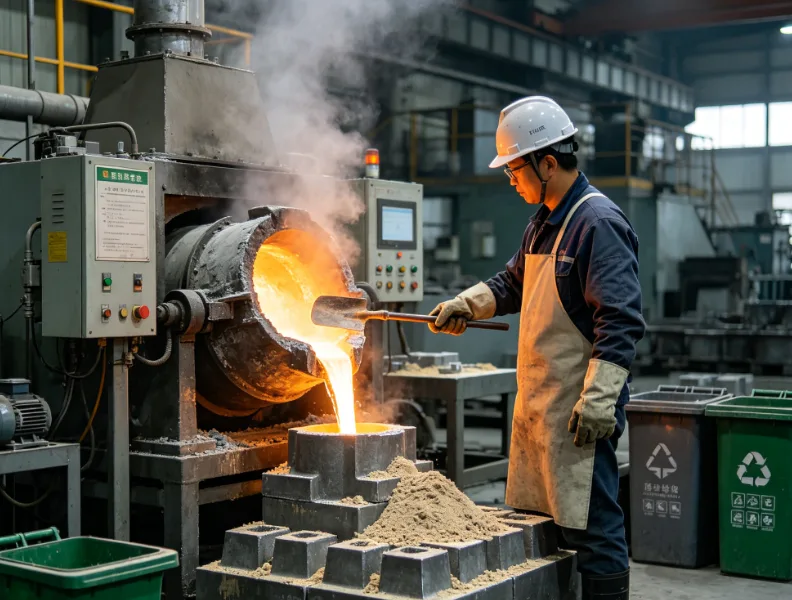
Green Manufacturing Trends Shaping the Future of Industrial Casting Factories
Green manufacturing is reshaping the industrial casting factory by pushing process efficiency, cleaner energy, and tighter emissions control into everyday operations. For foundries, the shift is no longer optional; it is becoming a practical response to rising energy costs, stricter regulations, and customer demand for lower-carbon supply chains.
Why Green Manufacturing Matters in an Industrial Casting Factory
Green manufacturing is now a core production strategy, not just an environmental slogan. Industrial casting remains energy intensive because melting, holding, sand handling, and finishing all consume power and generate waste. The International Energy Agency reports that industry was directly responsible for 9.0 Gt of CO2 in 2022, about one quarter of global energy-system emissions, which shows why heavy manufacturing must improve quickly IEA industry emissions overview. In a casting plant, even modest gains in furnace efficiency, scrap recovery, and dust management can create measurable operational value.
Green manufacturing also helps foundries stabilize quality and reduce cost volatility. Better thermal control lowers rework, while cleaner material loops reduce landfill disposal and raw material losses. Many casting suppliers now treat energy, water, and waste as production variables, not side issues. That shift is especially important for buyers who compare total lifecycle performance, not just unit price.
Key Green Manufacturing Trends in Industrial Casting Factories
The strongest trend is energy efficiency in melting and heat treatment. The IEA notes that global energy efficiency progress remained weak in 2024, with primary energy intensity improving by only about 1% IEA Energy Efficiency 2024. For casting factories, that gap creates room for improvement through insulation upgrades, optimized charge calculation, furnace scheduling, and waste-heat recovery. These changes are often low-risk because they improve both emissions and throughput.
Another important trend is the move toward electric melting and lower-carbon power. While every site has different technical constraints, electrification is often easier to integrate where production is already batch-based. At the same time, many plants are combining renewable electricity with process automation to reduce idle time and peak demand. This approach is especially relevant for factories that produce medium-volume, high-precision components.
Material circularity is also advancing fast. Scrap sorting, sand reclamation, and return-gate optimization are becoming standard tools for reducing virgin input demand. The World Steel Association reported that 93 steel companies and associations contributed sustainability data in 2024, representing 956.1 million tonnes, or 51% of global crude steel production worldsteel Sustainability Indicators 2024. That scale matters because foundries increasingly operate inside broader metal supply chains where recycled content and traceability influence purchasing decisions.
Practical Green Manufacturing Measures for Casting Plants
Green manufacturing works best when plants focus on specific operational levers. In industrial casting, those levers usually include furnace efficiency, sand reuse, emissions capture, and digital monitoring. A clear starting point is to map material and energy flows from charge preparation to final inspection. That map reveals where heat is lost, where scrap is generated, and where process drift affects yield.
| Area | Green manufacturing action | Typical operational benefit |
|---|---|---|
| Melting | Optimize charge mix and furnace timing | Lower energy use and fewer rejects |
| Sand system | Increase reclamation and control moisture | Less waste and more stable molds |
| Finishing | Use dust collection and closed-loop cleanup | Better air quality and lower losses |
| Quality control | Apply sensors and real-time process checks | Earlier defect detection and less scrap |
Emissions control is another central part of green manufacturing. The U.S. Environmental Protection Agency states that iron and steel foundries are major sources of hazardous air pollutants and are subject to national emissions standards EPA foundry emissions standards. For plant managers, this means dust capture, ventilation design, and housekeeping are not only compliance topics; they are also part of operational resilience.
Automation supports green manufacturing by reducing variation. Sensors for temperature, humidity, and mold condition can improve repeatability, while digital dashboards help operators spot waste in real time. Predictive maintenance also matters because unplanned downtime can force inefficient restart cycles and increase energy loss. In many plants, the cheapest sustainability gains come from better control of routine processes.
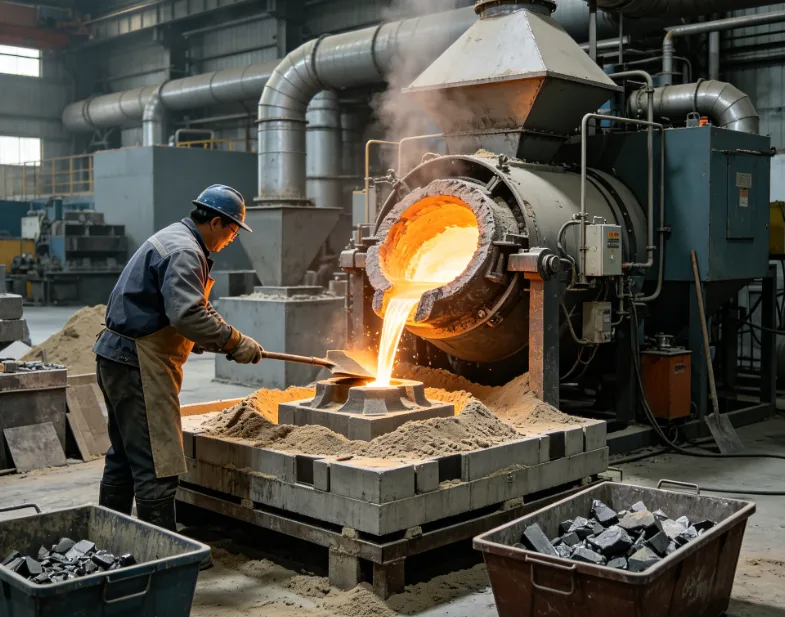
How Industrial Casting Factories Can Build a Cleaner Production Model
A cleaner casting model starts with process discipline. Factories should standardize input materials, reduce contamination, and align production schedules with energy availability. When a plant keeps charge composition consistent, it can improve metallurgical stability and reduce overprocessing. This is one reason green manufacturing and quality management often advance together.
Supplier selection is equally important. Buyers should evaluate whether a foundry can document recycled content, emissions controls, and waste handling practices. Some facilities also publish environmental performance data or align with external reporting frameworks. In steel-intensive sectors, the World Economic Forum notes that the industry is exploring cleaner routes such as electric arc furnaces and increased scrap use WEF Net-Zero Industry Tracker 2024. Although casting is not steelmaking, the same logic applies: lower-carbon input and efficient conversion usually produce better long-term outcomes.
For manufacturers looking for practical product categories and application coverage, the main casting capabilities usually include sand casting, investment casting, die casting, machining, and surface treatment. These categories help buyers match part geometry, tolerance needs, and material requirements to the right production route. A supplier home page such as the main casting company website can be a useful entry point for checking available services before moving into detailed technical review.
| Green priority | What to measure | Why it matters |
|---|---|---|
| Energy | kWh per ton of castings | Shows process efficiency |
| Waste | Reuse rate of sand and scrap | Indicates circularity |
| Air quality | Dust and fume capture performance | Supports compliance and health |
| Yield | First-pass acceptance rate | Reduces rework and hidden emissions |
What Buyers Should Look for in a Green Manufacturing Casting Partner
A credible green manufacturing partner should show process control, not just sustainability language. Buyers should ask for energy data, emission-control methods, and material traceability. They should also review whether the supplier can support design optimization, because part redesign often lowers weight, machining time, and scrap generation. A factory that understands both casting and lifecycle efficiency is usually better positioned for long-term supply agreements.
It is also useful to check product breadth. Foundries commonly organize their offer around core categories such as casting solutions, precision manufacturing, machined components, industrial parts, and custom metal components. Those categories help buyers locate suitable processes faster and compare whether a supplier can support prototyping, repeat production, and post-processing under one system.The Future of Green Manufacturing in Industrial Casting Factories
The future of green manufacturing in casting will be defined by efficiency, electrification, traceability, and waste minimization. Plants that act early will likely gain advantages in cost control, regulatory readiness, and customer trust. The strongest operators will treat sustainability as a production discipline built into furnace choice, materials management, and quality systems.
Long term, industrial casting factories will need to prove they can produce complex parts with fewer emissions per unit. That will require better data, cleaner energy, and tighter collaboration across the supply chain. Factories that adopt this mindset now will be better prepared for stricter standards and more demanding global buyers.
FAQ
1. What does green manufacturing mean in an industrial casting factory?
Green manufacturing in a casting factory means reducing energy use, emissions, scrap, and resource waste across the full production process. It includes furnace efficiency, sand reclamation, dust control, water management, and digital monitoring. The goal is to improve environmental performance without sacrificing product quality or throughput.
2. Which green manufacturing upgrade usually delivers the fastest return?
Energy-efficiency improvements often deliver the fastest return because melting and holding are major cost centers. Common upgrades include better furnace insulation, optimized charge mixes, reduced idle time, and heat recovery. These measures usually lower both utility bills and emissions, which makes them attractive for factories with tight margins.
3. Is electrification realistic for every casting plant?
Not every plant can electrify all processes at once, but many can begin with partial electrification or hybrid systems. Feasibility depends on part mix, furnace type, local grid quality, and capital budget. For some operations, the best path is a phased transition that starts with the most energy-intensive steps.
4. Why is sand reclamation important in green manufacturing?
Sand reclamation reduces landfill waste and lowers the demand for virgin materials. It also cuts material handling costs and can improve process consistency when moisture and contamination are controlled. In many foundries, sand reuse is one of the clearest examples of circular manufacturing with direct operational benefits.
5. What should buyers ask before choosing a green casting supplier?
Buyers should ask for evidence of energy management, emissions control, material traceability, and quality consistency. They should also review process range, such as sand casting or machining, to ensure the supplier fits the part’s technical needs. A strong partner should explain how sustainability is measured, not just advertised.