Introduction
Choosing materials for marine hardware castings means balancing corrosion resistance, strength, castability, and cost under constant exposure to saltwater, oxygen, and cyclic loads. The right alloy can extend service life dramatically, while a poor choice can lead to pitting, galvanic attack, cracking, and expensive replacement. This article explains which casting materials perform best in marine environments and how to compare them using practical criteria such as chloride resistance, mechanical properties, manufacturing suitability, and lifecycle value. With that foundation, the discussion can move from general requirements to the specific alloys most commonly used for dependable marine hardware.
Why Material Selection Determines Lifecycle Cost in Marine Hardware
Marine environments represent one of the most aggressive operational arenas for metallurgical components. With average seawater salinity hovering around 3.5% (35,000 ppm), hardware is subjected to relentless chloride-induced attack, galvanic corrosion, and mechanical fatigue. Selecting the appropriate alloy is not merely a design preference but a critical determinant of lifecycle cost.
When engineers under-specify materials, the resulting premature failures can multiply total ownership costs by three to five times compared to the initial capital expenditure. Conversely, over-specifying can unnecessarily inflate procurement budgets. Achieving the optimal balance requires a rigorous understanding of casting metallurgy and environmental variables.
Defining Marine Hardware Casting
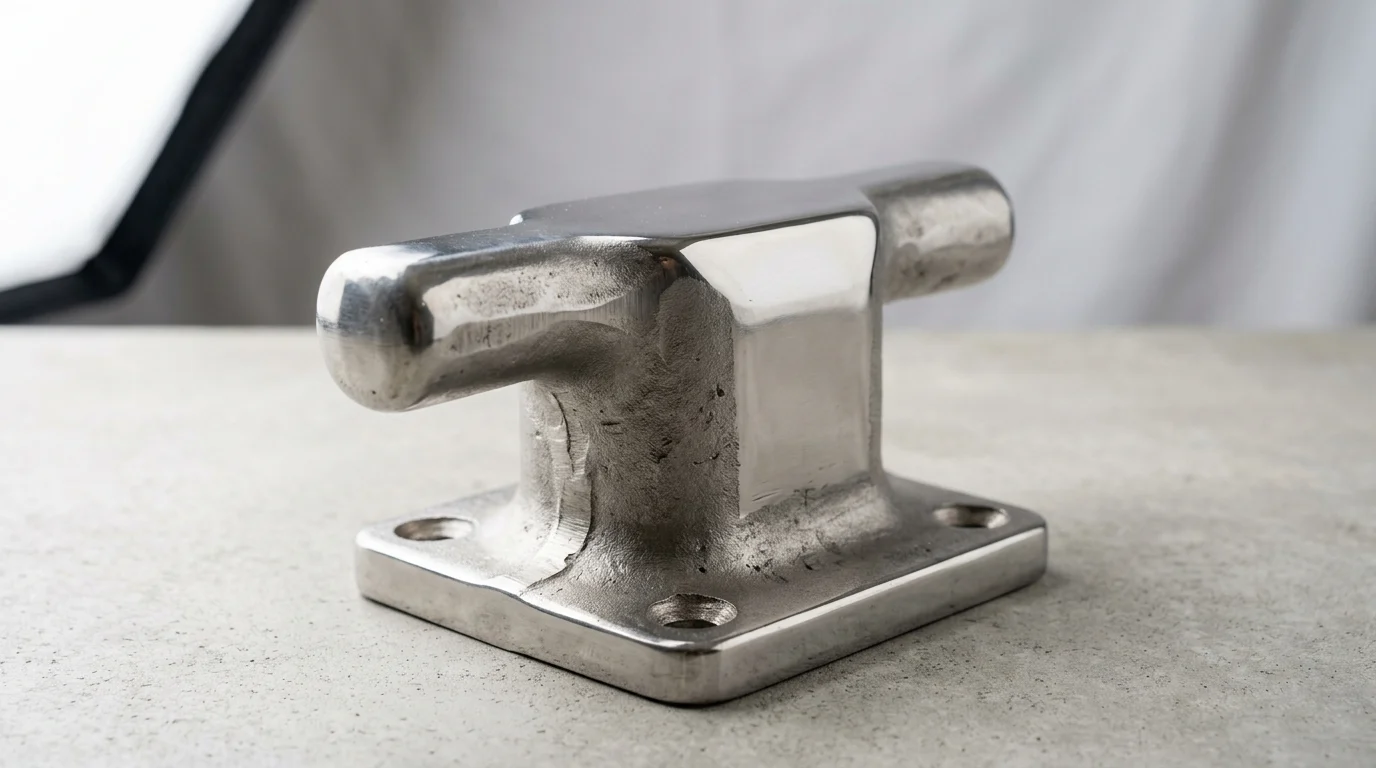
The production of marine hardware casting involves pouring molten metal into precisely engineered molds to form complex, near-net-shape geometries. Techniques such as investment casting and sand casting are utilized to manufacture critical components like cleats, chocks, thru-hull fittings, and propeller hubs.
Precision investment casting is particularly valuable for marine applications, routinely achieving tight tolerances of ±0.005 inches per inch. This dimensional accuracy minimizes secondary machining operations, thereby preserving the continuous microstructural integrity of the cast surface, which is vital for maximizing corrosion resistance.
Key Criteria for Comparing Corrosion-Resistant Materials
Evaluating alloys for marine deployment requires moving beyond basic tensile strength to assess specialized metallurgical metrics. The Pitting Resistance Equivalent Number (PREN) serves as a primary benchmark for chloride environments. A PREN exceeding 32 is generally mandated for continuous, long-term seawater immersion to prevent localized pitting.
Beyond PREN, engineers must evaluate galvanic compatibility to prevent accelerated corrosion when dissimilar metals are coupled underwater. Yield strength, measured in megapascals (MPa), and fatigue resistance dictate a component’s ability to withstand cyclic wave loading and high-stress mooring applications. For further context on application-specific metrics, reviewing marine hardware casting parameters provides insight into operational baselines.
Best Materials for Corrosion-Resistant Marine Hardware Castings
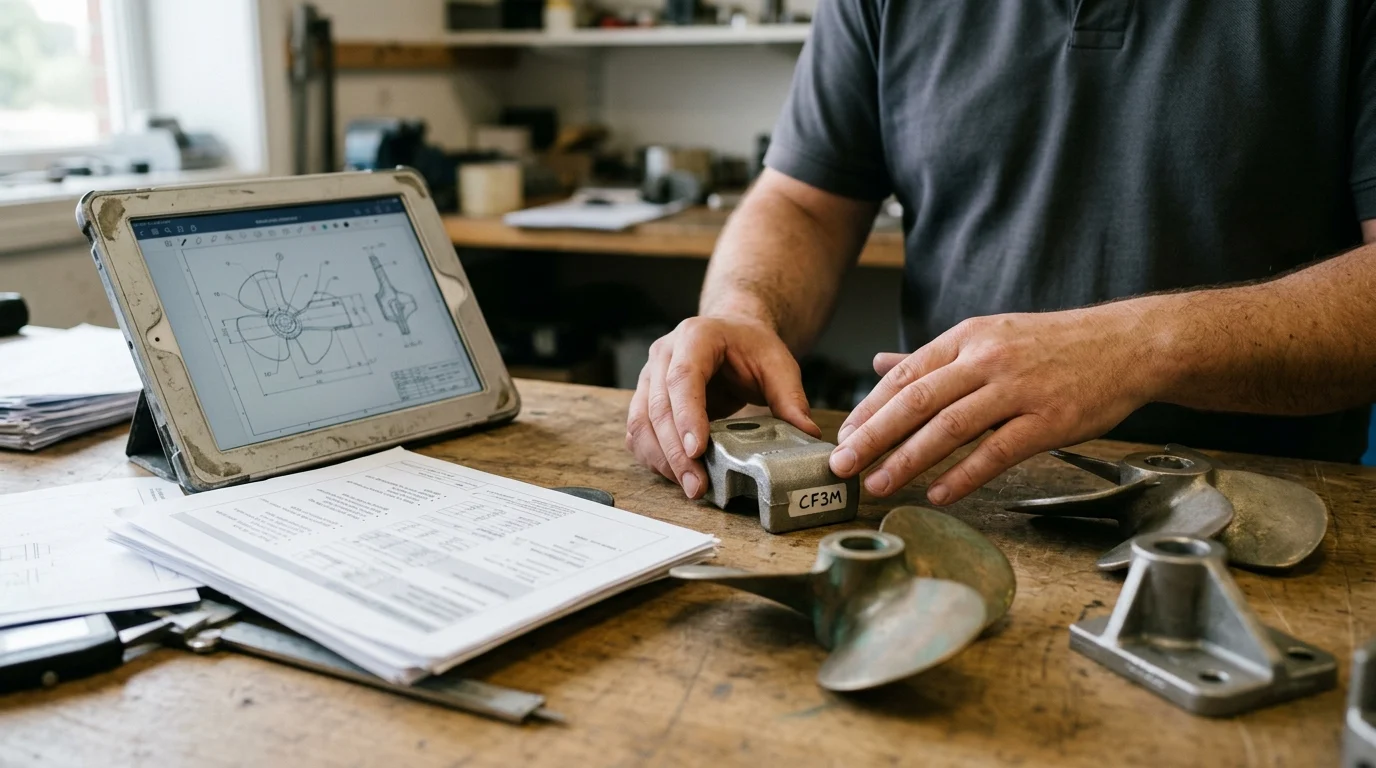
Selecting the optimal alloy for marine hardware requires balancing mechanical strength, corrosion resistance, and manufacturability. The metallurgical profile of the chosen material directly influences both the upfront tooling capital and the long-term maintenance cycles of the vessel or offshore structure.
Comparing Stainless Steel, Silicon Bronze, Aluminum Bronze, and Duplex Alloys
Marine engineers typically choose between several dominant alloy families, each offering distinct advantages in marine environments. The following table highlights the comparative specifications of these leading materials:
| Alloy Designation | PREN (Approx.) | Yield Strength (MPa) | Primary Marine Characteristic |
|---|---|---|---|
| 316L Stainless Steel | 23 – 28 | 170 | Standard above-deck aesthetics |
| Duplex 2205 | 35 | 450 | High-stress submerged structural use |
| Aluminum Bronze | N/A (Copper-based) | 250 – 400 | Heavy load bearing, anti-galling |
| Silicon Bronze | N/A (Copper-based) | 100 – 150 | Traditional hardware, moderate strength |
Standard 316 stainless steel casting remains the industry baseline for general-purpose marine hardware due to its passive chromium-oxide layer, though it is susceptible to crevice corrosion in stagnant seawater. Duplex stainless steels, combining austenitic and ferritic microstructures, deliver nearly double the yield strength of 316L and superior chloride stress-corrosion cracking resistance.
When to Choose Each Alloy
Alloy selection must be dictated by the specific operational zone of the hardware. 316L stainless steel is optimal for above-deck hardware such as stanchions, cleats, and hinges that benefit from regular washing and oxygen exposure to maintain their passive layer.
For continuously submerged, high-stress components like propeller shafts and rudder hardware, Duplex 2205 is the superior choice due to its high PREN and exceptional fatigue strength. Conversely, Aluminum Bronze is specified for heavily loaded bearings, impellers, and valve bodies; its high copper content (typically exceeding 75%) provides natural anti-biofouling properties, preventing barnacle and marine organism attachment while offering excellent resistance to cavitation.
How to Specify, Source, and Qualify Marine Hardware Castings
Transitioning from material selection to final procurement requires rigorous specification and quality assurance protocols. Sourcing castings without certified metallurgical reports and defined inspection criteria exposes projects to catastrophic mechanical failures. Engaging early with specialized marine hardware casting foundries ensures that engineering specifications align with practical manufacturing capabilities.
Process Steps That Reduce Failure Risk
To mitigate the risk of hidden internal voids or inclusions, procurement specifications must mandate comprehensive Non-Destructive Testing (NDT). Critical load-bearing components require 100% radiographic (X-ray) or ultrasonic inspection, ensuring internal defect rates remain well below the strict 1% threshold demanded by maritime classification societies.
Post-cast heat treatment is equally vital for structural integrity. For instance, austenitic stainless steel castings must undergo solution annealing at a minimum temperature of 1040°C followed by rapid quenching. This process dissolves harmful chromium carbides that precipitate at grain boundaries during cooling, fully restoring the alloy’s localized corrosion resistance.
A Decision Framework for Engineering and Procurement Teams
Engineering and procurement teams must collaborate to balance upfront tooling costs with long-term production efficiencies. Precision investment casting molds typically require an initial capital outlay ranging from $1,500 to $5,000, but they can reduce secondary CNC machining costs by 40% to 60% over the product lifecycle.
A robust procurement framework must finalize three critical parameters: strict chemical composition limits (requesting 3.1 material certificates), defined mechanical property minimums, and surface finish requirements. Specifying a surface roughness of Ra 3.2 µm or better, often achieved via electropolishing, eliminates microscopic crevices where chlorides can accumulate, thereby extending the operational life of the hardware.
Key Takeaways
- The most important conclusions and rationale for marine hardware casting
- Specs, compliance, and risk checks worth validating before you commit
- Practical next steps and caveats readers can apply immediately
Frequently Asked Questions
What is the best casting material for continuously submerged marine hardware?
Duplex 2205 is usually the best choice for submerged, high-stress parts because its PREN is about 35 and it resists pitting and stress-corrosion cracking better than 316L.
When is 316L stainless steel suitable for marine hardware castings?
Use 316L mainly for above-deck parts like cleats, hinges, and stanchions where regular washing and oxygen exposure help maintain its passive layer.
Why choose aluminum bronze for marine hardware castings?
Aluminum bronze suits heavy-load components such as bearings, impellers, and valve bodies because it offers strong wear resistance, anti-galling performance, and natural anti-biofouling behavior.
What inspection documents should I request when sourcing marine hardware castings?
Ask for certified material test reports, chemical composition data, mechanical test results, and clearly defined inspection standards before approving production or shipment.
How does casting method affect corrosion resistance in marine hardware?
Precision investment casting can improve fit and surface integrity by reducing extra machining, which helps preserve the cast surface and supports better corrosion performance.